

If you run a food delivery business, cloud kitchen, or QSR in Hyderabad, India, you’ve probably had this moment: a bag splits open mid-delivery, grease seeps through the bottom, or a customer receives a soggy, sagging package instead of a clean handover. Nine times out of ten, the culprit isn’t bad luck — it’s the wrong GSM.
GSM (grams per square meter) determines how thick and strong your paper is, and for SOS (Self-Opening Satchel) bags, getting this number right is the difference between a bag that performs and one that fails at the worst possible moment. Here’s how to choose correctly when buying SOS paper bags wholesale.
What Is GSM and Why Does It Matter for SOS Bags?
GSM measures paper density — the higher the number, the thicker and sturdier the paper. SOS bags, with their flat bottoms and squared design, are built to stand upright and carry weight, which makes GSM even more critical than in flimsier carry bags.
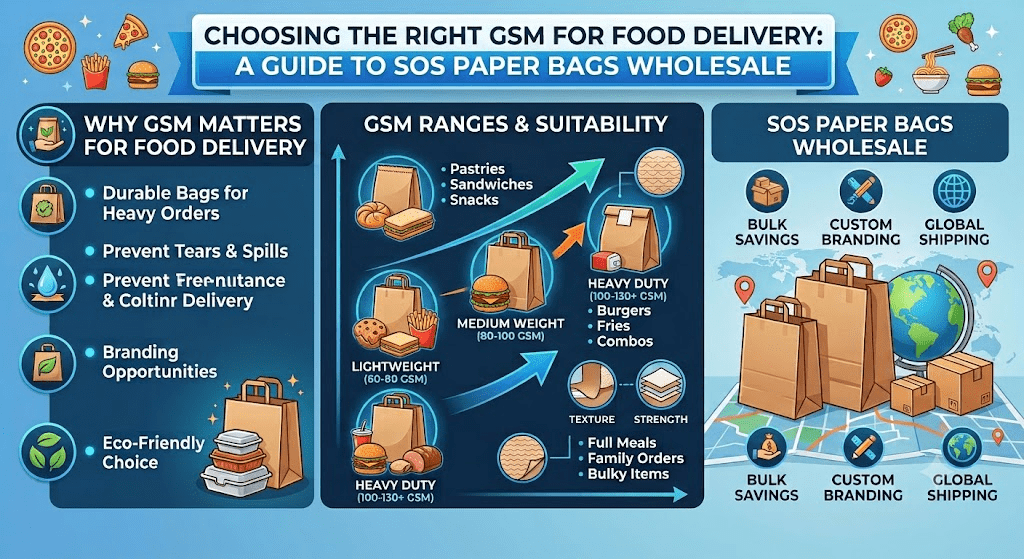
- Low GSM (under 90): Lightweight, cost-effective, but prone to tearing under moderate weight or moisture.
- Mid GSM (90–150): The sweet spot for most food packaging — strong enough for regular use, still economical for bulk orders.
- High GSM (150+): Heavy-duty, ideal for oily, heavy, or multi-item orders where durability can’t be compromised.
Choosing GSM isn’t about picking the thickest option available — it’s about matching paper strength to what the bag will actually carry.
Matching GSM to Your Food Delivery Use Case
Different food categories put different stress on packaging. Here’s a practical breakdown:
Light snacks and bakery items (70–90 GSM)
Think biscuits, samosas, sandwiches, or bakery goods. These items are light and low-moisture, so a lower GSM SOS paper bag keeps costs down without sacrificing function.
Standard meals and takeaway orders (100–120 GSM)
This is the most common range for restaurants and cloud kitchens delivering rice boxes, curries, or multi-item meals. It balances strength, grease resistance, and cost — making it the default choice for most SOS paper bags labs in Hyderabad orders.
Oily, heavy, or multi-course orders (130–150+ GSM)
Biryani, gravies, fried items, or bulk party orders need higher GSM paper with grease-resistant lining. Without it, oil seeps through, weakens the paper, and risks tearing before the bag even reaches the customer’s door.
Other Factors That Affect Bag Performance
GSM is important, but it doesn’t work alone. When sourcing SOS paper bags wholesale, also evaluate:
- Grease-resistant coating: Essential for Indian food delivery, where oil and moisture are the norm, not the exception.
- Bag base width: Wider, reinforced bases distribute weight better and reduce the chance of bottom blowouts.
- Handle strength (if applicable): For bags with handles, check stitching or gluing quality — this is often a bigger failure point than the paper itself.
- Print and branding needs: Higher GSM paper generally holds branded prints more crisply, which matters if packaging doubles as marketing.
Why Buying Wholesale (and Locally) Makes a Difference
For restaurants and delivery businesses, packaging isn’t a one-time purchase — it’s a recurring operational cost. Buying SOS paper bags wholesale rather than in small retail batches brings down per-unit cost significantly, which matters when you’re ordering thousands of bags a month.
Sourcing locally adds another layer of advantage. Working with paper bag manufacturers in Hyderabad India, means:
- Shorter lead times for reorders during peak seasons
- Lower freight costs compared to interstate shipping
- Easier communication for custom GSM, size, or branding requests
- Faster resolution if a batch doesn’t match your specifications
Anmol Bags supplies SOS paper bags in Hyderabad India, across multiple GSM ranges, with wholesale pricing and custom branding options for restaurants, cloud kitchens, and food delivery businesses. Working with a manufacturer that understands food-service packaging — rather than a generic paper bag supplier — means fewer surprises when your order arrives.
A Simple Way to Decide Your GSM
If you’re unsure where to start, ask three questions:
- What am I packing — dry, light items or oily, heavy meals? Heavier and greasier food needs higher GSM.
- How far is the average delivery, and how long does the bag sit in transit? Longer transit times increase the risk of grease seepage and structural fatigue, favoring higher GSM.
- What’s my acceptable failure rate? If even occasional bag failures damage your brand reputation (spills, complaints, refunds), it’s worth paying slightly more for higher GSM paper — the cost difference is minor compared to the cost of a bad delivery experience.
Final Takeaway
There’s no single “correct” GSM for every food business — the right choice depends on what you’re packing, how far it travels, and how much risk you’re willing to accept. As a general rule, most Hyderabad India, food delivery businesses do well with 100–120 GSM for everyday orders and should upgrade to 130+ GSM for oily or heavy items. Getting this right isn’t just a packaging decision — it directly affects customer experience, brand perception, and your bottom line through reduced waste and returns.
Frequently Asked Questions
What GSM is best for SOS paper bags used in food delivery?
Most food delivery businesses in Hyderabad, India, use 100–120 GSM for standard takeaway orders, while oily or heavy items like biryani perform better with 130–150+ GSM.
What does GSM mean in paper bags?
GSM stands for grams per square meter and measures paper thickness and density. Higher GSM means thicker, stronger paper.
Can low GSM SOS bags handle oily food items?
Not reliably. Low GSM paper (under 90 GSM) is better suited for dry, light items like bakery goods, as it’s more prone to grease seepage and tearing under oily or heavy loads.
Where can I buy SOS paper bags wholesale in Hyderabad India,?
Several paper bag manufacturers in Hyderabad India, offer wholesale SOS bags, including Anmol Bags, which supplies multiple GSM ranges with custom branding for food delivery businesses.
Are grease-resistant SOS bags different from regular SOS bags?
Yes. Grease-resistant SOS bags have an added coating or liner that prevents oil from soaking through the paper, which is especially important for Indian cuisine.
Does higher GSM always mean better quality?
Not necessarily. Higher GSM means thicker paper, but “better” depends on your use case. Using unnecessarily high GSM for light items adds cost without added benefit.
Can SOS paper bags be customized with restaurant branding?
Yes. Most wholesale manufacturers, including Anmol Bags, offer custom printing, sizing, and GSM selection to match specific restaurant or cloud kitchen requirements.
Why should I buy paper bags from a local Hyderabad manufacturer instead of other states?
Local sourcing typically means faster reorder turnaround, lower shipping costs, and easier coordination for custom specifications compared to interstate suppliers.
What’s the difference between SOS bags and regular flat paper bags?
SOS (Self-Opening Satchel) bags have a flat, square bottom that lets them stand upright and hold volume, making them better suited for food items compared to flat-style bags.
Is there a minimum order quantity for wholesale SOS paper bags?
Minimum order quantities vary by manufacturer and customization level. It’s best to contact a supplier like Anmol Bags directly to confirm current wholesale thresholds and pricing.