

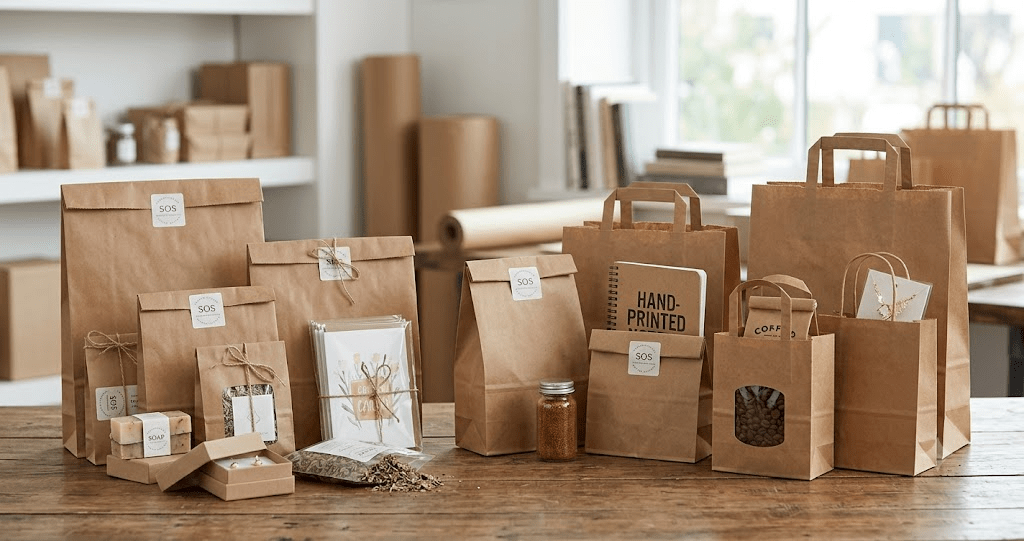
Not every product needs a handle, a gusset, or a box. Jewelry, cosmetics samples, bakery items, pharmacy orders, and small retail goods often just need something simple, secure, and cheap to pack in bulk. That’s exactly the gap flat and satchel paper bags fill — and it’s why businesses across India, from small retailers to national e-commerce sellers, keep coming back to them.
For businesses sourcing flat and satchel paper bags in Hyderabad,India, the appeal isn’t complicated: these bags solve a real packaging problem at a price point that’s hard to beat for small-item packing.
What Are Flat and Satchel Paper Bags, Exactly?
These two bag styles are often grouped together because they serve similar purposes, though their construction differs slightly.
Flat paper bags are simple, handle-less bags with a flat bottom and open top — essentially a paper envelope-style pouch. They’re commonly used for:
- Bakery items like cookies and pastries
- Small retail products like jewelry or accessories
- Pharmacy items such as medicine strips or small bottles
Satchel paper bags are similar in structure but typically slightly more reinforced, often with a small gusset or block bottom that allows them to stand upright and hold marginally bulkier items. They’re frequently used for:
- Takeaway snacks and quick-service food items
- Small grocery or convenience store products
- Gift shop and stationery items
Both styles skip the handle entirely, which is precisely where a large part of their cost advantage comes from.
The Core Reason They’re So Cost-Effective
Every added feature in a paper bag — handles, gussets, laminated finishes, reinforced bottoms — adds material and labor cost. Flat and satchel bags strip packaging down to its essential function: containing and protecting a small item.
Cost drivers that flat and satchel bags eliminate or reduce:
- No handle attachment — no rope, ribbon, or die-cut handle process needed
- Simpler machinery runs — fewer production steps mean faster manufacturing cycles
- Lower material usage per unit — smaller surface area than gusseted or larger carry bags
- Efficient stacking and storage — flat bags take up less warehouse and shipping space than bulkier bag styles
For businesses ordering in bulk, these savings compound significantly. A difference of even a rupee or two per unit becomes substantial across an order of 50,000 or 100,000 bags.
Where Flat and Satchel Bags Make the Most Sense
These bags aren’t a universal packaging solution — they’re purpose-built for specific use cases. They work best when:
- The item is lightweight — under roughly 500g to 1kg, depending on paper GSM
- A handle isn’t necessary — the product is carried inside another bag, box, or basket, or handed over directly
- High-volume packing is required — bakeries, pharmacies, and small retailers packing dozens or hundreds of items daily
- Branding still matters — flat surfaces are actually excellent for clean, visible logo printing
Retailers packing jewelry, cosmetics samples, spices, bakery goods, and pharmacy items across Hyderabad, India and other Indian cities have increasingly standardized on these formats specifically because they balance cost with functional adequacy.
Comparing Costs: Flat/Satchel vs. Other Paper Bag Styles
To understand the value clearly, it helps to see where flat and satchel bags sit relative to other common paper bag formats.
| Bag Type | Relative Cost | Best For |
| Flat/Satchel bags | Lowest | Small, light items, no handle needed |
| D-Cut handle bags | Moderate | Retail carry bags, boutique purchases |
| Twisted-handle bags | Moderate-High | Premium retail, gifting |
| Laminated carry bags | Highest | Luxury branding, heavier items |
This positioning is exactly why flat and satchel bags dominate high-volume, low-margin packaging needs, while other styles serve branding-forward or heavier-load use cases.
Sourcing Flat and Satchel Paper Bags in Bulk
Because these bags are ordered in high volumes by businesses like bakeries, pharmacies, and small retailers, sourcing decisions matter more than they might initially seem. A few factors determine whether a bulk order actually delivers the cost savings these bags promise:
- Consistent sizing — uniform bags reduce packing time and reduce product movement inside the bag
- Paper quality (GSM) — thin enough to stay cost-effective, but sturdy enough not to tear during handling
- Print clarity for branding — even simple flat bags benefit from crisp, legible logo printing
- Reliable bulk supply — businesses packing daily can’t afford supply gaps
This is where working with an established manufacturer becomes important rather than optional. Reliable paper bag manufacturers in Hyderabad, India who specialize in high-volume production can maintain consistent quality across large batches — something smaller, inconsistent suppliers often struggle to guarantee.
How Anmol Bags Supports Small-Item Packaging Needs
For businesses across India sourcing paper bags in Hyderabad, India, having a manufacturer who understands both cost efficiency and quality consistency at scale makes a measurable difference. Anmol Bags supplies flat and satchel paper bags designed specifically for high-volume, small-item use cases — bakeries, pharmacies, and retailers who need dependable packaging without paying for features they don’t need.
Making the Switch: A Practical Checklist
Businesses currently using more expensive bag formats for small, lightweight products can evaluate a switch to flat or satchel bags using this checklist:
- Audit current packaging spend — calculate per-unit cost of your existing bag style
- Identify products that don’t need handles — most small, hand-delivered, or counter-sold items qualify
- Request samples — test flat or satchel bags against your actual product weight and shape
- Compare bulk pricing — get quotes at your typical order volume, not small trial quantities
- Confirm branding options — ensure print quality meets your visual standards before committing to a large order
The Bottom Line
Flat and satchel paper bags aren’t a downgrade — they’re a deliberately efficient packaging choice for products that don’t need the extra material, structure, or cost of handled bags. For bakeries, pharmacies, jewelry sellers, and small retailers packing high volumes daily, these bags deliver the right balance of cost, function, and brand presentation, making them one of the smartest packaging decisions a small-item business can make.
Frequently Asked Questions
1. What’s the difference between flat and satchel paper bags?
Flat paper bags are simple, handle-less bags with an open top, while satchel bags typically have a small gusset or block bottom, allowing them to stand upright and hold slightly bulkier items.
2. Why are flat and satchel paper bags cheaper than other paper bag styles?
They eliminate handle attachments, use less material per unit, and require simpler production processes, all of which reduce per-unit manufacturing costs, especially at bulk volumes.
3. What items are best suited for flat and satchel paper bags?
Lightweight items like bakery goods, jewelry, cosmetics samples, pharmacy products, and small retail items are ideal, since these bags work best without needing a handle.
4. Can flat and satchel paper bags be custom printed with a business logo?
Yes. Their flat surface actually makes them well-suited for clean, visible logo printing, and most manufacturers offer custom branding options even for simple bag styles.
5. Are flat and satchel paper bags strong enough for daily retail use?
Yes, when the paper GSM matches the product weight. For lightweight items under roughly 500g to 1kg, these bags offer sufficient strength for daily handling.
6. How much can businesses save by switching to flat or satchel bags?
Savings vary by order volume and current packaging style, but businesses often see meaningful per-unit cost reductions when switching from handled bags to flat or satchel formats for suitable products.
7. Where can I source bulk flat and satchel paper bags in Hyderabad?
Established paper bag manufacturers in Hyderabad, such as Anmol Bags, supply flat and satchel bags in bulk, tailored for high-volume, small-item packaging needs.
8. Do flat and satchel bags work for businesses outside Hyderabad?
Yes. Many Hyderabad-based manufacturers ship paper bags in bulk across India, making them a cost-effective sourcing option for businesses nationwide, not just locally.
9. Are flat paper bags eco-friendly compared to plastic pouches?
Yes. Flat and satchel paper bags are biodegradable and recyclable, making them a compliant, environmentally responsible alternative to plastic pouches for small-item packaging.
10. How do I know if my product needs a handled bag instead of a flat or satchel bag?
If the item is heavier, needs to be carried over longer distances, or is a customer-facing retail purchase meant to be carried visibly, a handled bag like a D-Cut bag is usually more appropriate.