

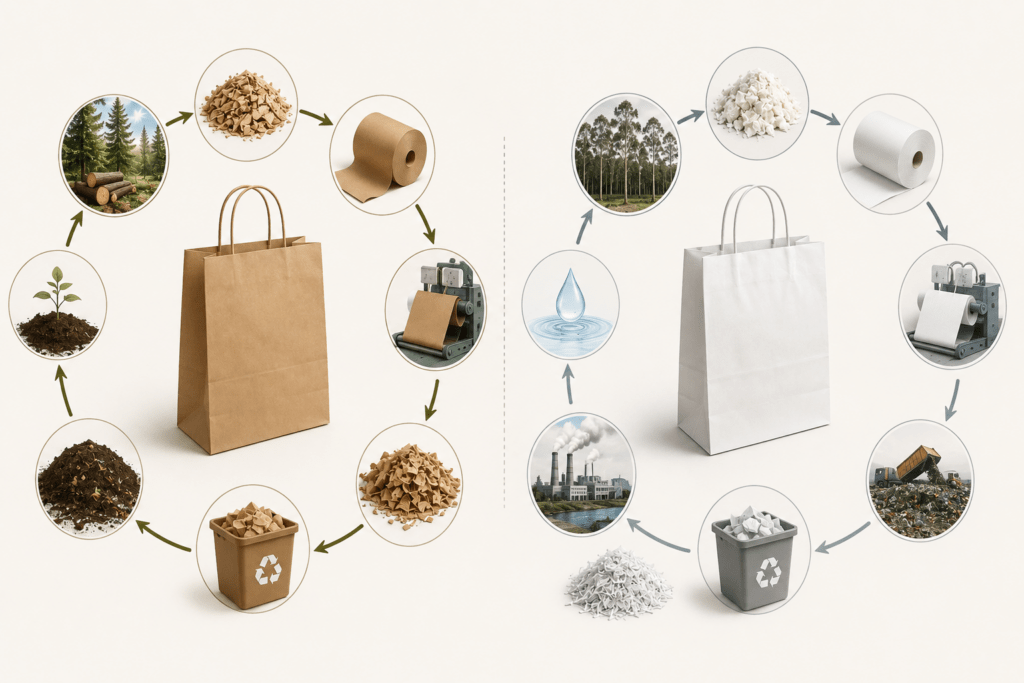
Two Bags. Same Shape. Very Different Stories.
Walk into any retail store, supermarket, or boutique today and you’ll spot both of them — the natural brown kraft bag and the clean white paper bag. They look like close cousins. Both are paper. Both are eco-friendly on the surface. Both are miles better than plastic.
But here’s what most buyers — retailers, brand managers, packaging procurement heads — don’t stop to think about: these two bags have genuinely different lifecycles. From the forest to your customer’s hand, and eventually back to the earth, the journey of a brown kraft bag and a bleached white bag is not the same story.
If sustainable packaging is something your business genuinely cares about — and not just as a marketing line — this breakdown is worth your time.
Where It All Begins — The Raw Material Stage
Both brown kraft and white paper bags start with wood pulp. That much is the same. What happens next is where they part ways.
Brown kraft paper is made using the kraft pulping process, which uses wood chips cooked in chemicals to separate the fibres. Crucially, the pulp is left largely unbleached. The natural lignin content stays in the paper — which is what gives it that distinctive brown colour and remarkable tensile strength.
White bleached paper goes through additional chemical processing — typically using chlorine-based or oxygen-based bleaching agents — to strip out the colour and achieve that bright white finish. The paper becomes smoother, more printable, and visually cleaner. But it requires more processing steps, more water, and more energy to get there.
From a purely raw material standpoint, brown kraft is the lighter footprint option.
Strength, Use, and Reusability — The Middle of the Lifecycle
This is the part most buyers care about on a practical level.
Brown kraft paper bags are genuinely strong. The unbleached fibres retain more of their natural strength, which means these bags hold up well under weight, resist tearing, and — at the right GSM — can be reused multiple times before they show wear. They’re a natural fit for grocery bags, SOS bags, food packaging, and anything where durability matters more than aesthetics.
White bleached paper bags, on the other hand, are the preferred choice when presentation is the priority. The smooth surface takes printing beautifully — colours pop, logos look sharp, and the overall finish feels premium. That’s why fashion retailers, gift shops, cosmetics brands, and boutique stores tend to gravitate toward white bags. They simply look better on a counter.
In terms of reusability, both perform similarly at equivalent GSM levels. The difference is really in what each bag is designed to do during its active life — functional heavy lifting versus brand-forward presentation.
At Anmol Bags, both brown craft paper bags and white craft paper bags are manufactured with quality-controlled GSM grades — so whether you need raw strength or a clean printable surface, the performance is consistent across batches.
End of Life — What Actually Happens When the Bag Is Done
This is the part of the conversation that genuinely separates the two.
Brown kraft bags biodegrade relatively quickly. Because they’re minimally processed, the fibres break down naturally in soil or composting environments. They’re also widely recyclable — most municipal paper recycling systems accept them without issue. The absence of heavy bleaching chemicals means there’s less concern about what leaches into the environment during decomposition.
White bleached bags are also recyclable and biodegradable — but the bleaching process does introduce processing chemicals into the paper’s history. Modern bleaching methods, particularly Elemental Chlorine-Free (ECF) and Totally Chlorine-Free (TCF) processes, have significantly reduced the environmental impact compared to older methods. So a white bag from a responsible manufacturer is far less problematic than white paper from a decade ago.
The honest takeaway: both bags are dramatically better than plastic at end of life. Brown kraft has a marginal environmental edge simply because it requires less intervention to produce and decompose. But a well-made white bag from a manufacturer using modern bleaching processes is still a genuinely sustainable choice.
What This Means for Retailers and Brands Making Packaging Decisions
If you’re sourcing paper bags in Hyderabad or placing bulk orders for your retail chain, food business, or export requirements, the choice between brown and white really comes down to three honest questions:
What are you packing? Heavy, functional items — go brown kraft. Lightweight, premium retail products — white works better.
How important is branding? If your bag is a brand touchpoint, white’s printability gives you more to work with visually. Brown kraft has its own rustic, natural aesthetic that works brilliantly for organic brands, artisan food labels, and eco-conscious retail positioning.
What’s your sustainability story? If you’re communicating actively about your environmental commitments to customers, brown kraft gives you a more straightforward narrative. But white bags from responsible manufacturers are a perfectly defensible choice — as long as you know what you’re buying.
Why Anmol Bags Is the Right Manufacturing Partner for Both
Anmol Industries has been one of the most trusted paper bag manufacturers in Hyderabad, India for over a decade. Operating from Malakpet, Hyderabad, they manufacture both brown kraft and white craft paper bags — across multiple sizes, GSM grades, and custom printing requirements.
Their MOQ starts from 5,000 pieces per size, which suits everything from growing retail businesses to large supermarket chains ordering PAN India. And because they’ve been doing this for ten years, the consistency in quality across batches is something repeat buyers genuinely rely on.
Whether you’re a supermarket in Chennai, a fashion boutique in Mumbai, a food brand in Delhi, or an exporter procuring from Hyderabad — Anmol Bags handles the full range of requirements.
Reach out at anmolbags.com or call 6300445745.
Final Thought
Brown kraft and white bleached paper bags are both solid, sustainable alternatives to plastic. The lifecycle differences are real but nuanced — and for most businesses, the right choice comes down to use case, brand positioning, and print requirements rather than one being outright better than the other.
What matters most is that you’re working with a manufacturer who understands both — and produces both consistently well.
FAQs
Q: Which is more eco-friendly — brown kraft or white bleached paper bags?
Brown kraft has a slightly lower environmental footprint due to minimal processing, but white bags made with modern bleaching methods are still a responsible, sustainable choice for retail packaging.
Q: Can both brown and white paper bags be custom printed with a brand logo?
Yes, both types are available with custom printing at Anmol Bags — white paper offers sharper colour reproduction, while brown kraft gives a natural, earthy aesthetic that works well for organic and artisan brands.
Q: What is the MOQ for brown kraft or white paper bags at Anmol Industries?
The minimum order quantity starts from 5,000 pieces per size for both brown kraft and white craft paper bags, with options for plain or custom-printed finishes.